REPORT 2019
Social, ethics and transformation committee report
Dear Stakeholder,
The enactment of s72(4) and s(5) of the Companies Act, No 71 of 2008 (the Act), read with Regulation 43, marks the most significant shift in the history of corporate accountability and reporting in South Africa. The Act requires AYO as a listed company to appoint a social and ethics committee (committee) to report on company performance in respect of non-financial aspects involving social, economic and environmental governance. Furthermore, the incorporation of the United Nations Global Compact and OECD requirements, which are voluntary standards in other jurisdictions, into local corporate law.
The ambit of the areas over which the committee is to exercise oversight covers legislated matters with which the Company must comply, for example, employment equity, B-BBEE and health and safety. Companies are not only required to comply but report to shareholders on their performance in these areas. Other aspects covered by the Committee entail non regulated matters. These matters may go to the heart of a company’s reputation which, if there are breaches, may result in erosion of the value of the company.

The transformation path in the ICT sector has been in sharp focus over the past three years. As a company, AYO has a broad view of its role in society and is strongly committed to supporting social and economic transformation. We take our responsibility in this regard seriously and aim not simply to be compliant, but to create value within our communities and society and to pursue initiatives with real tangible and measurable impact in the lives of its intended beneficiaries.
Our committee assists the Board to lead transformation within the Group and to ensure that there are appropriate policies and procedures in place to address transformation by levelling the playing fields both socially and economically for broader participation by all South Africans. We view the development of SMME businesses as the foundation for economic growth and job creation. With this, our Transformation Charter has a deliberate focus on black, youth, disabled and women-owned businesses within the sector, our supply chain and beyond. We recognise B-BBEE as a moral and commercial necessity, important to secure a more sustainable growth path for our society in general.
One of the key competitive advantages of the AYO Group has always been its strong B-BBEE credentials. Our 100% black ownership and 100% black management have served us well in 2019 yet again and we maintained our level 3 B-BBEE contributor certification. However, we recognise that as a listed company now, we no longer have full control over our ownership and thus, focus our efforts on improving our scores on all other qualifying criteria to ensure we maintain this advantage.
The committee views maximising AYO’s socio-economic spend as a logical step in this direction and has been actively engaging with the Board to achieve that. Our aim has been to identify and recommend opportunities to the Board to fully allocate the CSI budget amounts as prescribed by the B-BBEE Code in a way that supports our score card credentials while delivering the best possible value to recipients and their communities. During the reporting period, the Group has invested more than R6.2 million in Enterprise Development (ED) initiatives, primarily via the Inyosi Fund, which provides ED loan funding to black-owned businesses.
We have also pioneered a supplier development program that aims to improve the economic participation of black-owned SMEs into our supply chain by providing them with business development support services together with tailored financial solutions. The support available to participants ranges from coaching and mentoring to technical training.
The South African banking ecosystem is traditionally conservative in their approach to lending. While this is wonderful news for the country’s economic stability, as a whole, it does create challenges for entrepreneurs and launching businesses who struggle to access finance to get off the ground. Recognising our role in the broader South African economic context, the AYO Group invested R100 million in the establishment of a FinTech Fund to support start-up and emerging tech companies. With our integrated commitment to enterprise development and societal value creation, the committee will play an active role in the operations of the fund going forward.
In addition to our investment in ED initiatives, further R3.6 million was spent on transformation programs that foster technology learning culture within black communities and provide the necessary tools and resources to prepare learners for the work environment. Our goal was to approach skills development holistically, and our methodology was to address all aspects of technology skills education by investing in a variety of projects:
- Infrastructure:
Sponsorship of School Computer Labs for primary and secondary schools across the country, through several separate non-profit organisations. Overall more than 10 such state-of-the-art technology labs were created benefiting thousands of learners from various vulnerable societal groups (including people with disabilities); - Economic support:
In collaboration with the Masinyusane Development Organisation special grants were allocated to high-achieving disadvantaged young learners in Port Elizabeth to ensure their readiness to enter, succeed and excel in university. - Job shadowing opportunities:
Work-integrated learning programs were rolled out during the school holidays of learners in their final years of secondary education through our TechnoGirl Campaign.
Internally, we work to identify opportunities for development and empowerment of our staff to enhance performance by “growing our employees”. By encouraging our staff to be their best and grow, we aim to establish a culture of inclusivity, respect and operational excellence and thus become “an employer of choice” in the marketplace. But as Frances Hessbein said: “Culture does not change because we desire to change it. Culture changes when the organisation is transformed; the culture reflects the realities of people working together every day.”
The core values integrated in our culture are those of authenticity, accountability, innovation, caring and empowerment. We acknowledge that by fostering entrepreneurial spirit, creativity, experimentation and collaboration, we will be better able to create sustainable value for the employees themselves, our organisation and all our stakeholders. Thus, we actively seek out and encourage these qualities in people through all our processes from hiring to training and development programs to performance assessment and appraisals.
Our organisation is rapidly growing and that begets a need to identify and develop potential leaders from within who will ensure stellar performance against targeted milestones and steer AYO’s further expansion plans. Executive development programs were put in place for that during the reporting period, paying specific attention to high potential and high performing black and women employees. Deliberate creation of learnerships, internships and apprenticeships opportunities has been the second leg of our staff development strategy with 27 such positions implemented in 2019, advancing rare yet sought-after technical skills.
With the number of development initiatives on the go, both internally and externally, we are looking forward to an even busier 2020 for the social, ethics and transformation committee. Our key priorities for the coming year are to:
- Streamline and formalise our qualifying criteria and application process for ED and CSI funding;
- Develop and implement a monitoring and evaluation process to measure the impact and success rate of CSI initiatives supported by the Group;
- Further focus on staff development opportunities both in terms of executive development programs and learnerships/internships;
- Additional staff training initiatives, particularly in the area of compliance training and skills aligned with the business’ strategic goals.
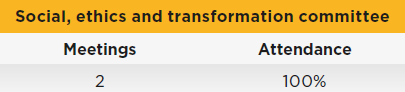
I would like to extend my gratitude and appreciation to the committee members for the dedication and hard work during the year. They have proven to be a highly committed team, achieving 100% attendance of all committee meetings and actively participating in identifying opportunities, supporting the management team and staff in developing processes and assisting in all possible ways to promote good corporate citizenship throughout the organisation. I thank Sello Rasethaba, who resigned from the committee in June 2019 for his contribution and officially welcome Rosemary Mosia, joining us in his place. Much work still lies ahead for us and I look forward to reporting on many successful implementations in 2020.

Dr Dennis George
Chairman of Social, Ethics and Transformation Committee
31 January 2020