REPORT 2019
Audit and risk committee report
Dear Stakeholder,
On behalf of the Audit and Risk Committee, I am pleased to present this report for the financial year ended 31 August 2019, as recommended by the King Code, the JSE Listing Requirements and the Companies Act.
The audit and risk committee consists of four independent non-executive directors, all of whom have the requisite business acumen and experience as well as financial skills to fulfill the committee’s duties. Executive directors, internal auditor and representatives of the appointed external auditor also attend the committee’s meetings by invitation.
The committee’s primary purpose is to ensure the integrity of the financial statements and to oversee the effectiveness of the internal financial controls and the internal and external audit functions. Additionally, we assist the Board in carrying out its duties relating to accounting policies, internal controls, financial reporting practices and identification of significant risk exposure.

We feel strongly that effective risk management is dependent on timeous and honest communication and have unrestricted, continuous interaction with the executive management team. We maintain open contact with the external auditors who may communicate directly with myself and all other committee members throughout the year. I am also available at the Annual General Meeting to answer any questions about the committee’s activities.
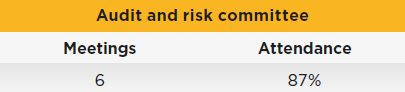
We met five times during the reporting period and reviewed all significant risks and challenges and assessed the adequacy of internal controls and the combined assurance delivered over the identified risks. We monitored the effectiveness of the controls put in place through reviewing reports from management, internal audit and the external auditors and ensure the quality of financial reporting by reviewing the 2019 interim financial results and the 2019 annual financial statements. We also reviewed the impact of the Company’s long-term strategy against pertinent factors in technology and communication, including cyber security and governance compliance to ensure that risk management was applied appropriately.
Constitution and Risk Management Charter
A formal audit and risk constitution and risk management charter was approved by the Board and adopted during 2019. The documents set out the duties and responsibilities of the committee itself, as delegated to it by the Board, namely:
- Provide oversight of the effectiveness of the internal and external audit function;
- Assist the Board in overseeing the quality and integrity of the Group’s annual financial statements, the integrated reporting process and any other announcements in respect of financial results;
- Review the effectiveness of the Chief Financial Officer and the finance department;
- Provide oversight on the effectiveness of the design and implementation of internal financial controls;
- Review the effectiveness of the internal audit department;
- Review the quality of the external audit;
- Review and recommend to the Board for approval the interim results, preliminary results, the annual financial statements and the Integrated Report.
The committee executed its responsibility pursuent to paragraph 22.15(h) of the JSE Listing Requirements.
External Audit
The audit and risk committee has a formal audit and risk charter with formal rules governing the services provided by the external auditors in terms of systems and processes. During the year, we again reviewed this charter to ensure regulatory compliance and implemented it accordingly.
We looked at the cost and scope of the audit function as well as the non-audit services performed by BDO South Africa Incorporated (“BDO”) – the appointed auditors of the Group. Their team, led by Mr Stephan Cillié as the designated auditor for the 2019 reporting period, performed reasonably and professionally. After 21 years of being AYO’s auditors, BDO informed the Group that it will not be seeking reappointment for the next financial year. The committee has commenced with a tender process for the appointment of auditors at the next Annual General Meeting.
In addition to the financial results for 2019, BDO is also auditing the interim results of the Group for the six months ended 28 February 2019 and 28 February 2018 as requested by the JSE. These audited interim results will be published as soon as they become available.
Key Audit Matters Relating to the 2019 Audit
The committee considered the key audit matters for the reporting period as outlined in the independent auditor’s report for the Group. These key matters were:
- Business combinations;
- Valuation of goodwill and intangible assets;
- Completeness of related party transactions;
- The occurrence of related party transactions.
The committee was satisfied that these key audit matters were adequately addressed in the context of the audit.
Internal Audit
AYO Group has internal controls and systems designed to provide assurance as to the reliability and integrity of the financial statements. These systems are designed to manage, rather than eliminate, the risk of failure to achieve the Group’s business objectives. They can only provide reasonable and not absolute assurance against material misstatements or loss and to safeguard, verify and maintain accountability adequately for its assets.
Up until 30 April 2019, this function was fulfilled by the head of internal audit of our parent company – AEEI. Our rapid growth since listing, however, has resulted in increased scope for the internal audit function and the associated requirements for our internal audit entity. The committee resolved to appoint an internal candidate to conduct the internal audit function commencing in the 2020 financial year. The recruitment process was recommended to the Board on 15 November 2019.
Risk Management
A key outcome of the committee’s activities during the year was the approval of the risk charter, which forms the terms of reference for the integrated risk management process adopted by the Group. We evaluated:
- The effectiveness of the risk management process in place;
- Management’s reports pertaining to the effectiveness of the Group’s risk management, compliance processes and controls;
- The top risks (refer to Risk Management) that the Group is exposed to;
- Our responses to the top risks;
- Any new and/or emerging risks; and
- The alignment of the risk management process to respond and address these risks.
As detailed in the earlier pages of this report, we are confident that the processes and structures the Group has in place relating to risk identification and management are adequate and that the Group’s performance itself stands witness to the efficacy of these measures.
Technology and Information Governance
Information technology risk is of paramount importance to any modern organisation. The committee acknowledges the severity of implications posed by information technology threats and performs an oversight function over it. This includes identifying any breaches in the Group’s information systems in collaboration with management and the head of internal audit; effectiveness of
general information technology controls and review of emerging risks that may affect the information technology environment of the Group.
Financial Reporting
One of the key responsibilities of the audit and risk committee is to review the Group’s accounting policies and annual financial statements and ensure that they are in compliance with IRFS, JSE Listing Requirements and the Companies Act.
On 1 January 2018 IFRS 9 introduced new requirements for classifying and measuring financial assets and liabilities, including a new impairment model, which will result in earlier recognition of losses. These new standards are expected to be implemented in the Group’s 2019 financial statements. Our detailed assessment of the impact of the application of IFRS 9 indicates that apart from the application of the credit loss impairment model, there are no major deviations from the current classification of financial assets as they are largely in line with IFRS 9 and other loan receivables are not considered material. There will also be no major impact on the Group’s accounting for financial liabilities as the new requirements only affect the accounting for financial liabilities that are designated at fair value through profit and loss and the Group does not have any such liabilities. Our financial liabilities are accounted for at amortised cost.
Another set of standard changes arises from IRFS 15, which again was introduced on 1 January 2018 and will be adopted by the Group in the 2019 financial results. The core principle of IFRS 15 is that an entity recognises revenue to depict the transfer of promised goods or services to customers in an amount that reflects the consideration to which the entity expects to be entitled in exchange for those goods and services.
The Group generates revenues from various sources, including dividend income and interest income from loans advanced, of which detailed assessment has been done during the year whereby contracts were analysed within each division and the impact would result in additional disclosures subsequent to performance obligations. AYO is in the process of finalising its assessment and is documenting the impact thereof.
The new standard does not include guidance on the accounting for dividend income. Instead, guidance that is consistent with the existing requirements of IAS 18 has been incorporated into the financial instruments. Although dividend income arises in the ordinary course of the Group’s activities, it does not arise from contracts with customers and therefore may not be presented as revenue.
The committee reviewed the Group’s accounting policies and annual financial statements to ensure that they are in compliance with all currently effective regulations, including IFRS, the JSE Listing Requirements and the Companies Act. We acknowledged the findings contained in JSE queries and ensured that they were taken into account when the 2019 annual financial statements were prepared. We considered the appropriateness of the accounting policies adopted, the treatment of significant transactions and the process implemented by management for the preparation of these statements. We are satisfied that the statements fairly present AYO’s financial position for the year and that the Integrated Report is of the required quality and integrity.
Finally, the committee is tasked with ensuring the Chief Financial Officer has the appropriate experience and expertise to meet the responsibilities of the position and that the financial department is adequately resourced as per paragraph 3.84(g)(i) of the JSE Listing Requirements. Mr Tatenda Bundo was appointed to the position during the reporting period and we are pleased to have someone with his credentials in this responsible spot. He is a professional of the highest standard, has contributed significantly to the efficiency and accuracy of financial reporting and we are confident in his ability to lead AYO’s financial department.
Rosemary Mosia
Chair of Audit and Risk Committee
31 January 2020